Spray dryer Testing Facility About
Our company has a dedicated in-house spray drying testing and application laboratory for conducting trials on customer products and evaluating the suitability of spray drying technology before finalizing the commercial plant design. The facility enables us to conduct product-specific spray drying trials using different types of feed materials, including food, nutraceutical, pharmaceutical, chemical, herbal, botanical, dairy, protein, and specialty products. Key Capabilities Laboratory and pilot-scale spray drying trials. Evaluation of feed concentration, viscosity, and solids content. Optimization of inlet and outlet temperatures. Selection and optimization of atomization technology. Evaluation of rotary atomizer, two-fluid nozzle, and pressure nozzle systems. Determination of suitable feed rate and atomization parameters. Evaluation of powder recovery and cyclone/bag-filter performance. Particle-size and bulk-density optimization. Evaluation of moisture content and drying characteristics. Assessment of powder flowability, solubility, dispersibility, and product appearance. Evaluation of heat-sensitive products and controlled-temperature drying. Trials for encapsulation of flavours, aromas, oils, and active ingredients. Comparative trials using different drying parameters to establish optimum operating conditions. Trial-to-Plant Scale-Up The trial data generated from our in-house facility is used for process development and engineering scale-up. Based on the trial results, we can establish key design parameters such as evaporation capacity, feed rate, drying-air temperature, atomization system, air-flow requirements, powder recovery system, and utility consumption.
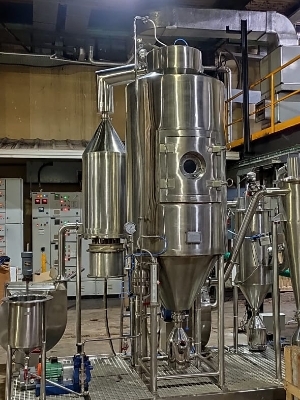
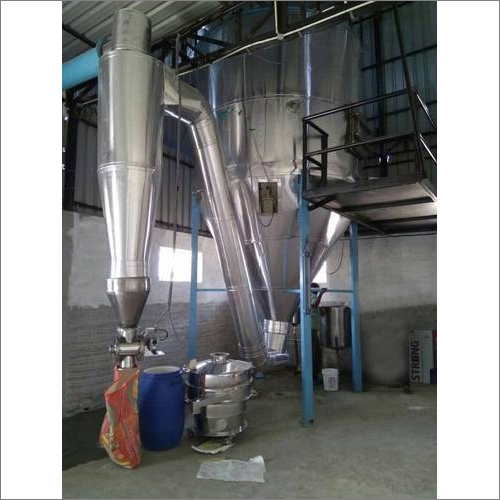
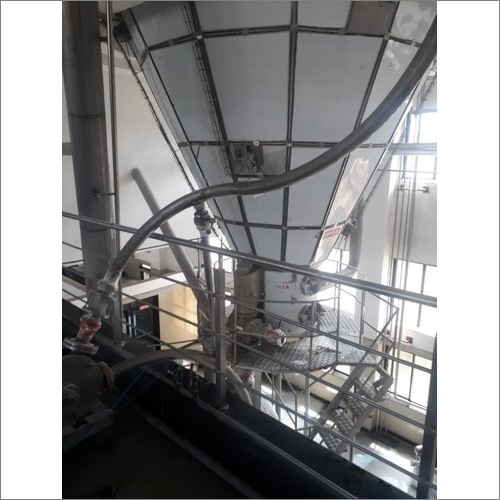
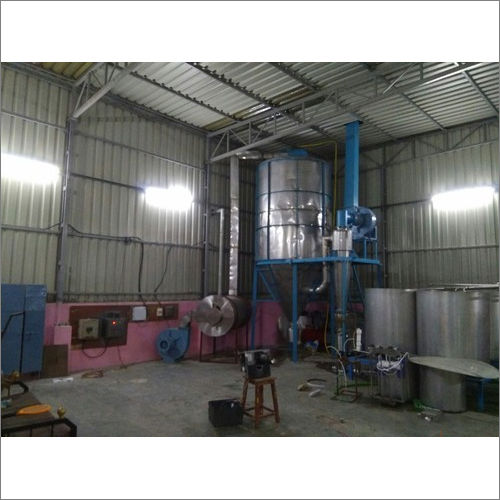
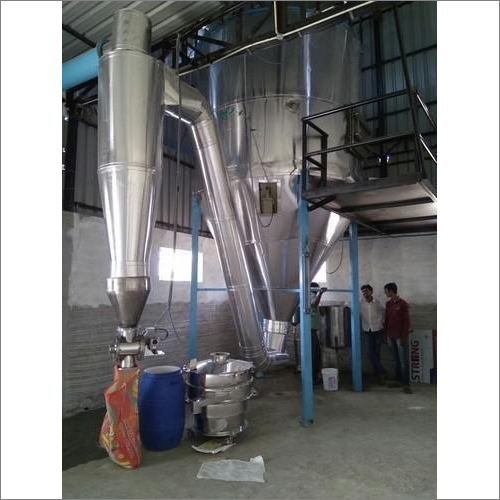
Versatile Atomization and Collection SystemsThe facility supports both rotary and nozzle atomization methods, providing flexibility for a wide range of product and process requirements. With an efficient cyclone separator and product collection tank, the system ensures maximum yield and clean separation of dried powder from process air, streamlining the workflow for laboratory and small production environments.
Advanced Control and Safety FeaturesState-of-the-art digital or analog control systems monitor critical parameters such as temperature and pressure, ensuring reliable and repeatable spray drying. The equipment comes equipped with overheat protection, emergency shutdown switches, and comprehensive safety systems, allowing researchers and operators to conduct trials confidently and safely.
Designed for Research, Development, and Small Scale ProductionTailored for laboratory and pilot-scale use, this spray dryer is ideal for R&D teams and manufacturers exploring formulation development, process optimization, or producing limited batch quantities. Its adjustable evaporation and air flow capacities accommodate a variety of applications, while its CIP-compatible design simplifies cleaning and maintenance between experiments.
FAQ's of Spray dryer Testing Facility:
Q: How does the spray drying process work in this testing facility?
A: Spray drying in this facility involves atomizing liquid feeds-such as solutions, suspensions, or emulsions-using either rotary or nozzle atomizers. The atomized droplets are dried rapidly by hot air, resulting in fine powder, which is separated and collected via a cyclone separator and collection tank.
Q: What types of liquid feeds can be processed with this spray dryer?
A: This facility is compatible with solutions, emulsions, and suspensions, making it suitable for a wide range of chemical, pharmaceutical, food, and material development applications.
Q: When should I use two-fluid or pressure nozzle atomization?
A: Two-fluid nozzles are ideal for atomizing viscous or heat-sensitive liquids, while pressure nozzles are preferred when processing less viscous feeds where higher throughput is desired. Selection depends on your product's properties and process objectives.
Q: Where is product collection carried out in this facility?
A: Product collection occurs in a dedicated cyclone separator, which efficiently separates dried powder from the air stream, depositing it cleanly into a collection tank for easy retrieval and further handling.
Q: What are the cleaning and maintenance requirements for this spray dryer?
A: The system features a CIP (Clean-In-Place) compatible design, enabling thorough internal cleaning without extensive disassembly. This feature is especially valuable for R&D and pilot production, ensuring cross-contamination is minimized between batches.
Q: How does the control system enhance operation and safety?
A: The facility can be equipped with either digital or analog controls, providing real-time monitoring of temperature and pressure. Safety mechanisms such as overheat protection and emergency shutdown switches are built-in to prevent accidents and ensure safe operation at all times.
Q: What are the primary benefits of using this facility for R&D and small batch production?
A: This spray dryer enables precise process control, consistent powder generation, and flexible operation for R&D teams. Its adjustable parameters and robust safety features support formulation development, process optimization, and efficient small-scale production without significant investment in large equipment.







 Send Inquiry


 Send Inquiry
 Send Inquiry
 Send SMS


